Showing posts with label candy. Show all posts

Thursday, May 31, 2007

Sugary Failure


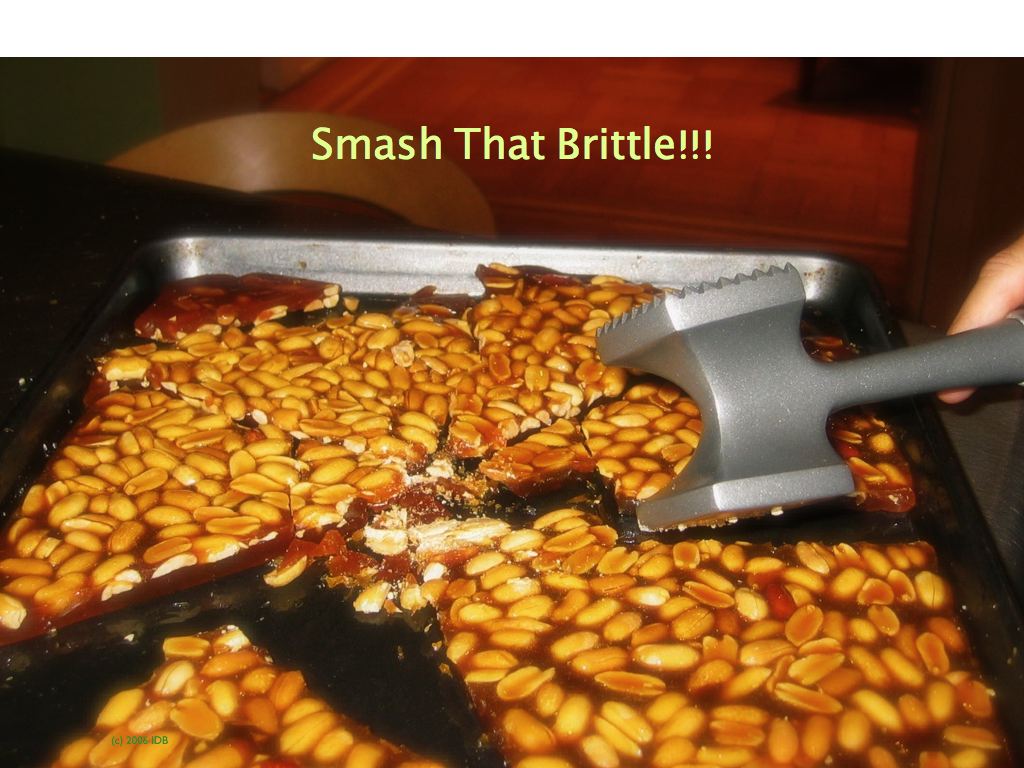
The picture you see above shows what happens when your candy recipe fails. This happened over the weekend at Fire Island while I was trying to make peanut brittle. I have made this recipe many times before and never had the sugar crystallize during cooking. So, after cleaning up the gigantic mess I made, I proceeded to try to investigate what went wrong.
One thing about the World Wide Web is that people rarely use it to discuss their own failures. If you Google "candy recipe failure" you will receive only one posting related to how a candy recipe doesn't work, and that one is mine. Nevertheless, with a little searching, I was able to find an excellent review on the variables and tricks in candy making on the website Baking911. The display on the site is a little busy for my taste, but it has excellent information. There is a more concise explanation (in fact I am sure one site lifted their facts from the other!) at Exploratorium.

Humidity, a fact of life on Fire Island, is the likely reason that my candy recrystallized on me. Since it would be difficult to wait for a dryer day, I looked to see what steps I could use to get me a decent batch of brittle.

Interfering agents are things that stop crystallization from occuring. Combining two sugars helps prevent crystallization because the sugars can't lock together as well. "Inverting" table sugar by adding acid, such as cream of tartar or lemon juice helps break down sucrose to glucose and fructose. For soft candies, such as caramel, cooked at lower temperatures, fatty things such as milk or butter also help reduce crystallization. My prior experience tells me this will not work for hard candies, as the milk or butter solids burn at higher temperatures.

I remade the batch, modifying my original recipe as follows:


HUMID BRITTLE RECIPE!
  • 4 cups sugar


  • 1 cup corn syrup


  • half of a squeezed lemon


  • 1/2 cup water

This solution boiled to 325 degrees without a problem. I then added lightly salted peanuts and the brittle was formed. My one note is that using a combination of sugars did seem to give a minimally more chewy result, although this may just be my imagination

Sunday, December 10, 2006

Don't Boil Molasses when Making Candy

Not quite that bad, but close. I was attempting to make an almond brittle with a salty, smoky taste and I decided to try to add molasses to the sugar and even to corn syrup and sugar mix. The results, after severak attempts, are painful to look at and even worse to clean up. At about 250 degrees or so, the mix, even with only a small amount of molasses, started to boil over and foam. Interestingly, this did not happen when I used maple syrup in a similar way. Adding a small amount of molasses after heating the sugar does work, and you still get a hard, tasty candy. More on this later. I tried to research why molasses foams so much when heated above this temperature but no one seems to have tried. In traditional "Internet echo syndrome" everyone repeats the same ancient "molasses candy" recipe which conveniently does not give a temperature to heat the molasses to but rather says to "boil it" etc. One recipe did give a temperature, but my candy was already boiling to a foamy mess at the 260 degrees they recommended for their recipe. At 290 or so (the softball stage) it was burnt.

Monday, October 30, 2006

The Importance of Temperature


Just a brief note on the importance of temperature in candy cooking. I remade the maple peanut brittle I made last week. This time, I let it cook to between 320 to 325 degrees(closer to 325 but not over) rather than actually letting it hit 325 degrees. The result was a less smoky brittle. It was extremely tasty, and boy 1 preferred it this way. The lovely wife enjoyed the smokier taste. I am still amazed at how such a tiny detail made a real difference in the taste of the food. Even a roast seems to be somewhat more flexible.

Saturday, October 21, 2006

Maple Peanut Brittle is Fabulous!


Last night, in addition to having hockey puck Chinese buns from the West Village and an excellent roast (more on this later) I decided to make peanut brittle. There was no real reason, other than it seems easy and I've always liked it. It was a success. And as soon as I post this, I am heading right to the gym to make up for all the brittle I've eaten (or maybe I'll play another round of Lego Star Wars). The key ingredient is salt, which you add. As we all know from snack food commercials, there is a balance between salty and sweet. The peanuts in brittle should not be devoid of salt, this upsets the taste balance. But a standard salted peanut has too much salt, and the taste balance is so bad you will need a drink to wash the stuff down. By controlling the salt, you become the master of the balance, which certainly is better than Frito-Lay doing it for you (although I think they claim to control Salt and Crunch).


INGREDIENTS

5 cups sugar
1/3 cup maple syrup
1/2 cup water
1/4 teaspoon cream of tarter

Eight ounce can unsalted cocktail peanuts (the Planter's Can)
3 tablespoon warm butter (not melted)
Kosher salt (probably about 3/4 teaspoon)

KITCHEN EQUIPMENT YOU WILL NEED

Good 4 or 5 quart pot
wooden spoon, greased with canola oil
candy thermometer
Cookie sheet, greased with canola oil and left in the fridge until needed
Large bowl to hold peanuts and salt them.
Pastry brush or bar-b-que brush (I use the latter)

INSTRUCTIONS

Put water, cream of tartar, sugar and maple syrup in the pot. Place the candy thermometer in the pot. Put heat on medium-low. Stir gently. When mixture starts to boil, wet the pastry brush with water and brush off any crystals on the side of the pot. Stop stirring, and raise heat to medium. During this time, put the peanuts in a bowl and add salt. The peanuts should have a very mild salty taste.

When the thermometer hits 310 degrees, start watching carefully. When it hits 320, stare. If you like lighter brittle, remove from heat immediately. If you like a darker smokier brittle, wait till it gets to 325 degrees. In either case, immediately add peanuts and butter to the pot and stir with the greased wooden spoon. When mixed, carefully pour onto the greased cookie sheet. If the sheet is to large, you can use the spoon to minimize the surface area of the brittle. It should be about 1/4 " thick. Let cool and you have brittle. Remove from cookie sheet with a spatula and smash into brittle sized pieces with a meat tenderizer. Makes a lot.

Failure on Fruit Become Success on Ice Cream

Earlier this week, I tried to make caramel apples, using a recipe from Gourmet Magazine. It was an abject disaster. However, there was a large amount of caramel left over, which I placed in a greased bowl in the refrigerator and covered with plastic wrap. Salvage of this golden goo was attempted and I am happy to report that it was a success. We heated the caramel in a double boiler and it made an excellent topping for ice cream. The caramel kept well in the fridge and was just soft enough to easily spoon into the double boiler. I am not sure it would freeze well, but the caramel would definitely last quite a while covered in the fridge. After heating and remelting it loses its shape and needs to be thrown out.

Thursday, October 19, 2006

Failure at Caramel Apples


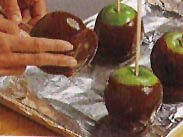
I screwed up the caramel apples. Now, I don't really think I screwed them up, I think the recipe stinks. It is from Epicurious.com, which usually has good recipes. Not this time. Although the caramel is somewhat tasty, it is to soft to stay on the apples and most fell off. There is a little warning that they give you about that, complete with this rather benign looking picture of someone pushing caramel back onto the apples (those fingers are from epicurious.com). Its a lot of sticky pushing for a dozen apples. Even Male Martha has better things to do (in this case, go to the Ranger's game). The good news is that all of the leftover caramel sits in a greased bowl and will be an excellent topping for ice cream.

Wednesday, October 11, 2006

Candy is Cool

I have become obsessed with candy. Not that I want to eat it, but the whole temperature really matters thing is cool. We made candy apples last week (recipe soon) which were a great success, and I just finished making butter cream icing for a cake for the 10 year old's birthday. There is a great site at Exploratorium.edu which explains the science of candy and the various terms used such as soft-ball, hard ball, hard crack, etc. (where else could so much talk about balls and cracks be considered educational?). There are also some recipes and a video showing how some factory in California makes multicolor lollipops.